
Bridal Makeup with a Kasavu Saree: Colour and Balance
A kasavu saree offers a beautiful starting point for bridal styling because its light fabric and decorative border leave room for individual interpretation. Rather than treating it as a formula for one makeup look, consider how the fabric, blouse, jewellery and hairstyle will frame your face during your celebration in Kannur.
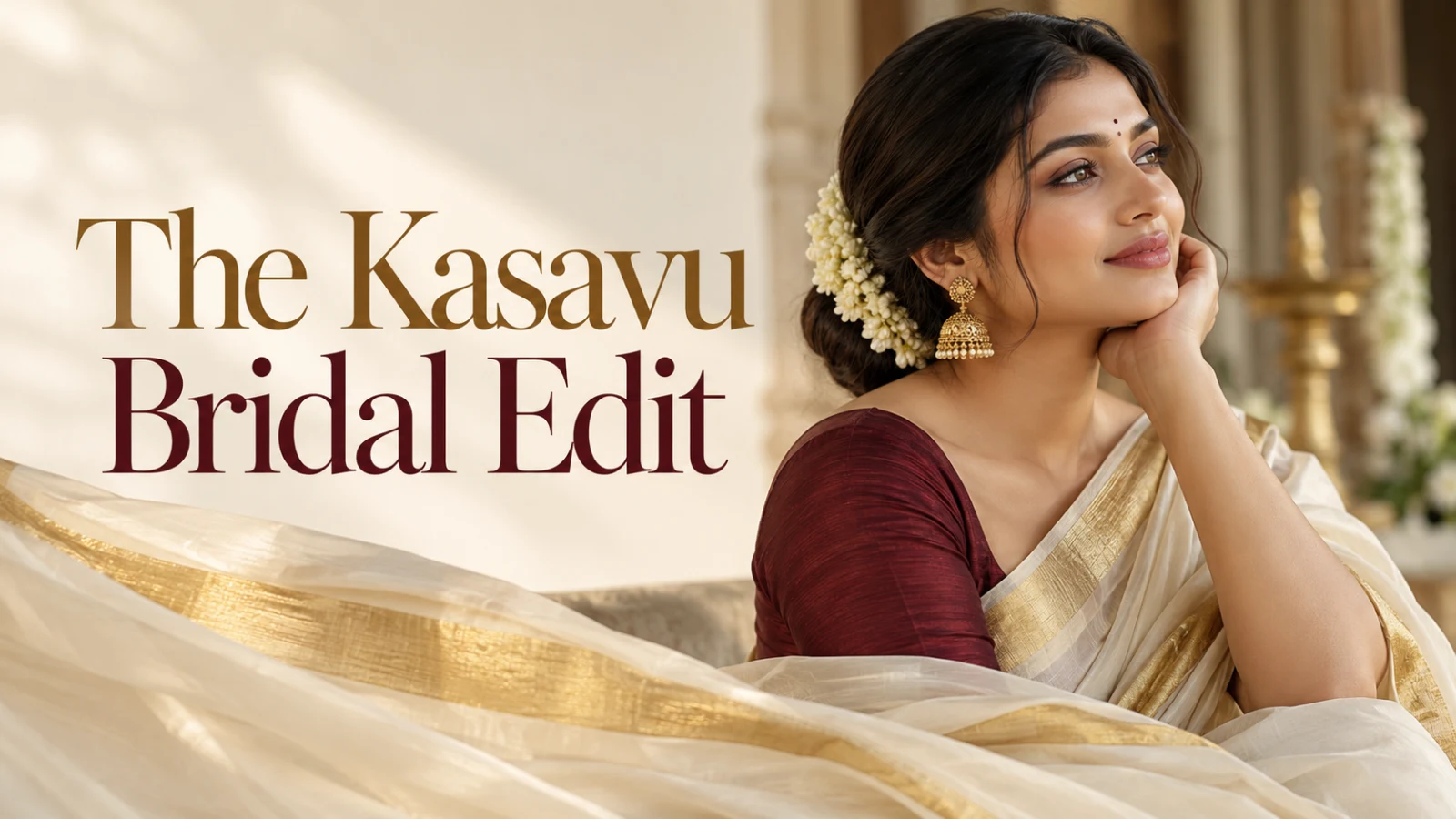
A kasavu saree offers a beautiful starting point for bridal styling because its light fabric and decorative border leave room for individual interpretation. Rather than treating it as a formula for one makeup look, consider how the fabric, blouse, jewellery and hairstyle will frame your face during your celebration in Kannur.
Look at the blouse as well as the border
Two outfits described as a kasavu saree can create very different impressions. A contrasting blouse changes the colour story, while embroidery or a high neckline adds visual detail close to the face. Share the full outfit instead of only a close-up of the saree border. This helps you discuss whether the eye makeup, lip colour or jewellery should provide the strongest accent. A small connection with the blouse can feel more considered than copying the gold border into every part of the makeup.
Use gold as an accent rather than an instruction
Gold jewellery and a gold border do not automatically require a strongly metallic eyelid. You can choose a gentle reflective detail, a largely matte eye or a more defined finish depending on what you enjoy. Compare the makeup idea with the amount of jewellery you plan to wear. The same principle applies to highlighter and hair accessories: each reflective surface adds to the overall impression. Decide where you want the light and detail to be most noticeable before adding another repeated gold element.
Check the silhouette from the side
A saree look includes the line of the drape, the position of the hair and the shape of the earrings. A side view can reveal whether those elements sit comfortably together. If flowers form part of the hairstyle, think about their scale alongside the blouse and jewellery. Ask for the hairstyle to be reviewed with the main accessories in place, rather than imagining their final position. This makes it easier to adjust a detail before the full look is complete and helps the styling feel coherent beyond the front-facing portrait.
Coordinate hair and makeup as one look
Decide how the hairstyle and makeup will share attention. Hair lifted away from the face may make an eye look or earring shape more visible, while loose texture can soften the outline around the cheeks. A detailed hair accessory can change how much sparkle you want near the eyes. Review the two parts together instead of finalising them through separate reference collections that never meet. This does not mean both need the same degree of detail. One can be more restrained while the other provides the main visual interest. The useful measure is how the finished combination supports your features, outfit and preferred level of expression.
Pack by the order you will need things
Place clothing, jewellery, hair accessories and finishing items in separate labelled groups. Arrange them in the order they will be used rather than putting every small object into one large bag. Keep a photograph of the complete outfit if several pieces are being carried by different people. Check fastenings and pairs of earrings before the day, when there is still time to locate a missing component. A clear packing system prevents a planned beauty sequence from stopping repeatedly while someone searches for an item. It also makes repacking easier later, when everyone is tired and borrowed accessories need to return to the right person.
Choose comfort for the hours after the photographs
The first photograph captures a moment; you will continue wearing the look afterwards. Think about greeting guests, sitting for a meal, moving between rooms and sharing time with family. A detail that looks striking in a reference may feel different when you wear it for several hours. Discuss weight, movement and how much maintenance you are comfortable doing. Let your artist know if you prefer to avoid a particular sensation or regularly find an accessory awkward. These details are part of the design brief. A well-considered look should support the celebration rather than require you to monitor it constantly from the sidelines.
Set a clear limit for last-minute changes
Make the main choices before the preparation day whenever possible. Leave room for useful adjustments, but distinguish an adjustment from a completely new direction. Changing an entire eye look, hairstyle or accessory arrangement can affect other parts of the schedule. If you are unsure about a decision, say so early rather than hoping the uncertainty will disappear after the finishing products are applied. A short written summary of the agreed direction can help everyone remember what was discussed. On the day itself, review new suggestions against the outfit, available time and your original preferences. A calm plan can still be flexible without becoming a fresh consultation every few minutes.
Choose coverage by area rather than by habit
Different areas of the face may need different amounts of coverage. You might want a little more correction around one area while preferring a lighter layer elsewhere. Describe the result you want to see rather than requesting maximum coverage everywhere by default. Your artist can discuss how the finish works with the condition of your skin and the rest of the look. Natural skin texture remains visible even in carefully applied makeup. Looking at the complete face from an ordinary conversation distance is often more useful than examining every pore in a magnifying mirror. The goal is a considered finish that suits your preferences, not an unrealistic promise of perfectly textureless skin.
Compare the face with the neckline
Foundation discussions should include the visible neck and upper chest, particularly when your outfit has an open neckline. Looking only at a small area of the face can make the finished combination feel disconnected. Colour differences can also be exaggerated by shadows, jewellery and the tone of the fabric close to your skin. Ask to review the overall result in a balanced light with the outfit neckline visible. The answer is not automatically to apply the same amount of product to every exposed area. It is to consider how the face reads within the complete look and choose a comfortable, appropriate approach with your artist.
Balance one strong feature at a time
A noticeable eye, a defined lip and a highlighted cheek can each work beautifully, but deciding which deserves the strongest emphasis makes the overall look easier to read. Start with your favourite feature or the element that best suits the occasion. Then discuss how the other areas can support it. A soft lip does not have to mean a pale lip, and a restrained eye can still have clear shape. Balance is also affected by jewellery and hair, so review the full combination before adding more contrast. The most useful question is whether each extra detail improves the look you wanted, rather than whether there is room to add another product.
Check eye makeup with your eyes open
An eye look is experienced in movement, not only in a closed-eye photograph. Check the design with your eyes open and your face relaxed. Look ahead, smile and glance down so you can see which details remain visible in ordinary expression. The shape of the lid, the position of a liner and the placement of shadow all contribute to that impression. Explain whether your priority is a soft outline, stronger definition or a particular colour. A reference can guide the mood, but the placement may need to change for your features. Judge the result on your own face rather than on how closely a closed-eye close-up resembles another person's image.
Plan your look with Eloria
Eloria focuses on bridal makeup, hairstyling and occasion beauty in North Kerala, especially Kannur. Share your celebration date, exact location, ready time, outfit details and the services you are considering. These details help the team discuss a suitable look and a realistic preparation schedule. Availability and the final scope should be confirmed directly before treating your date as booked.
Frequently asked questions
Does a kasavu saree need red lipstick?
No. Red is one option; softer, deeper or more neutral shades can also work according to the full outfit and your taste.
Should I match my eye makeup to the gold border?
An exact match is optional. Consider how much metallic detail is already present in the jewellery and fabric.
What outfit photographs should I send?
Send a full saree and blouse view, plus close-ups of important colours, embroidery and jewellery.
Can I wear my hair down with a kasavu saree?
Discuss the look you enjoy, your hair and the outfit neckline. There is no single required hairstyle.
How do I keep the look from feeling too busy?
Choose a main focal point and let other details support it, rather than repeating the strongest accent everywhere.